Route Optimization Benefits: ROI, Cost Savings & More Stops
Route optimization delivers measurable results: fewer miles, lower fuel spend,
reduced overtime, more stops per driver, and better on-time performance.
The biggest gains come when you use constraints like time windows
and multiple vehicles.
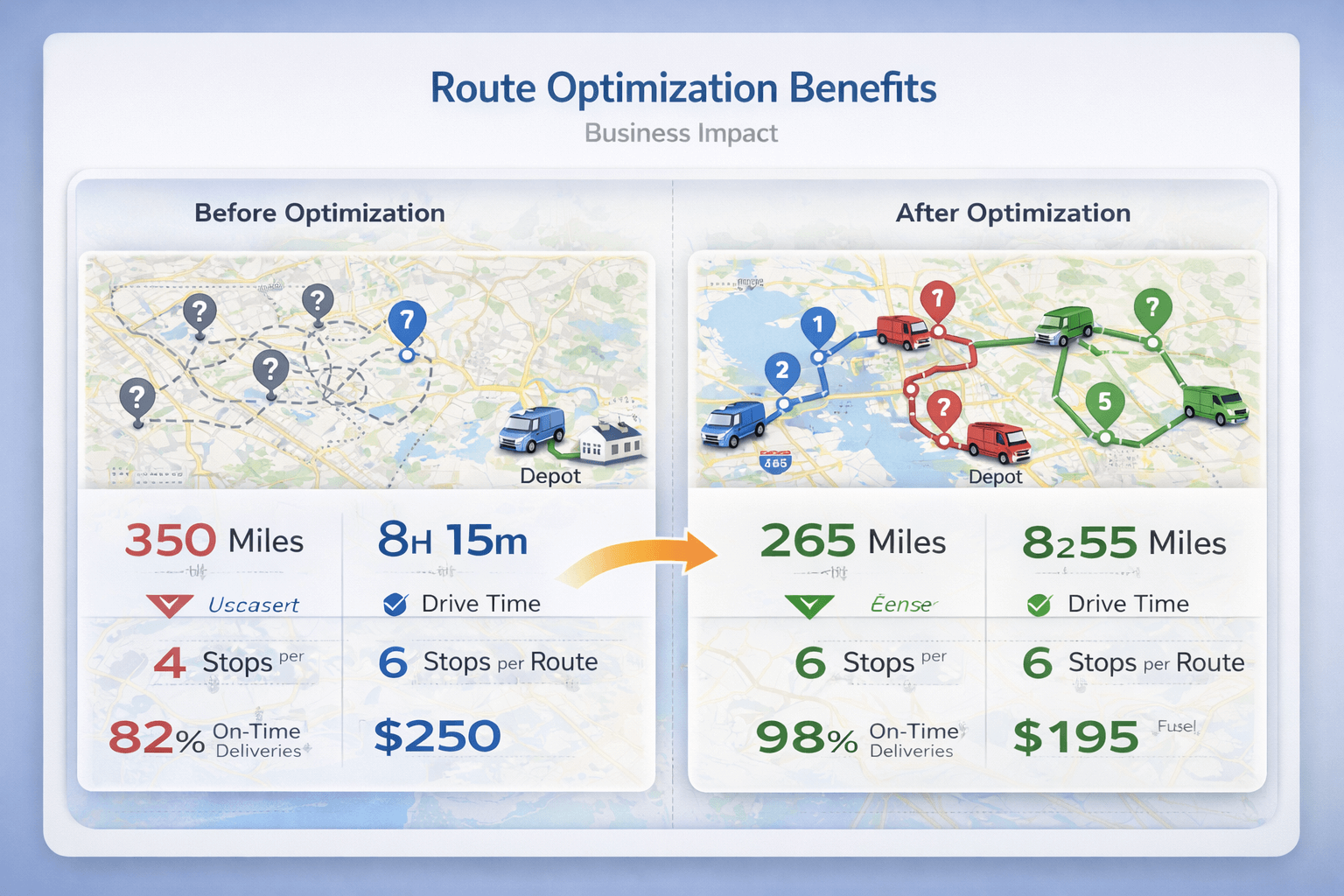 Route optimization reduces miles, saves time, and improves on-time delivery across fleets.
New to routing? Start with the pillar guide:
Route Optimization Guide.
Top benefits of route optimization#
Route optimization benefits show up in four areas: cost, capacity, service, and planning effort.
- Lower fuel and mileage cost: fewer miles driven and less idle time.
- Reduced overtime: shorter, more feasible routes that finish closer to shift end.
- More stops per driver: less driving time means more productive hours.
- Better on-time performance: routes built around time windows and service time.
- Fewer missed/failed stops: less “route breaks” caused by unrealistic plans.
- Faster dispatch planning: route creation in minutes instead of hours.
If you’re comparing tools, see:
Best route optimization software
and Route optimization vs Google Maps.
Cost savings: fuel, labor, and vehicle wear#
Fuel savings (miles and idle time)
Fuel is the easiest benefit to measure because it is directly tied to miles driven and time spent in traffic/idle.
Reduce miles and you typically reduce fuel spend and emissions at the same time.
Labor savings (drive time + overtime)
Shorter routes and realistic schedules reduce overtime and make staffing more predictable.
Teams also spend fewer hours “fixing routes” in the morning.
Maintenance savings (tires, service, replacement)
Fewer miles reduces wear: tires, oil changes, brake service, and long-term vehicle replacement costs.
It also reduces unexpected breakdown risk caused by overuse.
Productivity gains: more stops per day (without adding drivers)#
Route optimization increases daily capacity because it cuts backtracking and wasted driving.
The result is often more stops completed per driver with the same fleet size.
- Better stop sequencing: fewer detours and less backtracking.
- Balanced routes: distribute stops across drivers instead of overloading one route.
- Feasible schedules: include service time and working hours so routes hold up in the real world.
For multi-driver operations, this page supports the biggest gains:
Route optimization with multiple vehicles.
Customers experience routing problems as late arrivals, missed windows, and unpredictable ETAs.
Route optimization improves reliability by planning around constraints, not just distance.
- More on-time arrivals: schedules designed around time windows.
- Fewer missed deliveries: fewer impossible routes.
- More accurate ETAs: service time and realistic sequencing improves time estimates.
If you operate by appointment windows, prioritize:
Route optimization with time windows.
Dispatcher efficiency: planning routes in minutes, not hours#
Manual routing is slow and inconsistent. Dispatchers often spend hours dragging stops on a map or reordering spreadsheets.
Route optimization reduces that work to a repeatable workflow.
- Less manual route editing: consistent routing rules produce consistent outcomes.
- Faster day-of changes: re-optimize quickly when stops cancel or new orders arrive.
- Lower stress: fewer “fire drills” caused by broken schedules.
How to measure ROI from route optimization (simple framework)#
To measure ROI, track your baseline for 2–4 weeks, then compare against optimized routes using the same stop volume.
Step 1: Track baseline metrics
- Total miles per day / per route
- Total drive time (hours)
- Stops per driver per day
- Overtime hours
- Late or missed stops
Step 2: Convert improvements into dollars
- Fuel savings = miles saved × cost per mile
- Labor savings = hours saved × labor cost per hour
- Overtime reduction = overtime hours saved × overtime rate
- Service savings = fewer failed stops × cost of re-delivery / customer credits
Step 3: Compute ROI
ROI = (Annual savings − Annual software cost) ÷ Annual software cost
ROI example (copy/paste numbers)#
Here’s a simple example you can adapt:
| Metric |
Before |
After |
Change |
| Total miles/day |
500 |
425 |
-75 miles (15% reduction) |
| Drive time/day |
10 hrs |
8.5 hrs |
-1.5 hrs |
| Overtime/day |
1.0 hr |
0.3 hr |
-0.7 hrs |
If your all-in costs are $0.85 per mile and $25 per labor hour:
- Fuel/vehicle savings: 75 × 0.85 = $63.75/day
- Labor savings: 1.5 × 25 = $37.50/day
- Total savings: $101.25/day → ~ $26,000/year (260 workdays)
The point isn’t the exact number—the point is having a consistent method.
FAQ#
What are the main benefits of route optimization?
The main benefits are fewer miles driven, lower fuel costs, reduced overtime, more stops per driver, better on-time performance, and faster dispatch planning.
How much can route optimization reduce driving time or distance?
Many teams see 10–30% reductions in drive time or distance, depending on stop density, constraints like time windows, and how routes were previously planned.
How do you measure ROI from route optimization?
Measure before vs after changes in miles, drive time, stops per day, overtime, and late/missed stops. Convert improvements into dollars using your cost per mile and labor cost per hour, then compute ROI = (savings − software cost) ÷ software cost.
Does route optimization help with time windows and appointment scheduling?
Yes. Time-window optimization schedules stops within allowed arrival ranges and improves feasibility, on-time performance, and ETA reliability.
Can a small business benefit from route optimization?
Yes. Even a single driver with many stops can reduce drive time and backtracking by optimizing stop order and accounting for service time and schedules.
Ready to Reduce Miles and Increase Stops?
Optimize routes online in minutes — add stops, add vehicles, apply time windows, and generate optimized routes instantly.
Start Route Optimization
View Pricing